Superbridge withdrawals follow the selected route's waits and completion steps
Superbridge withdrawals complete after the waits and remaining transactions required by the selected bridge. Native optimistic exits include challenge periods and may require separate proving and finalization transactions. Faster provider routes follow different settlement processes, while Circle's Cross-Chain Transfer Protocol (CCTP) V2 transfers support manual completion and automatic relaying.
Updated
In short: Native withdrawal costs include the network fees for any later proof or finalization transactions that the route requires.
Route options and remaining withdrawal work
Route choice determines whether an exit faces native protocol waits, provider availability or a relayer's completion process. Quotes describe the expected steps before initiation, so follow-up actions can influence the choice alongside fees and expected output. Third-party withdrawal routes can finish in minutes where available.
| Withdrawal option | Completion work | Blocking condition |
|---|---|---|
| Optimism or Arbitrum native bridge | Challenge period and remaining route transactions | Delayed prerequisites or withdrawal invalidation can extend the wait |
| Across route | Execution through a usable provider quote and its returned steps | An error result supplies no executable quote |
| Manual CCTP V2 | Manual completion for Fast or Standard routes | Minting needs Circle's attestation and a submitted mint transaction |
| Superbridge-relayed CCTP V2 | Automatic completion for FastAuto or StandardAuto routes | Minting still needs Circle's attestation |
| Circle-relayed CCTP V2 | Automatic completion through Fast or Standard forwarder routes | Attestation retrieval can delay minting |
| Wormhole-relayed CCTP V2 | Automatic completion through Fast or Standard executor routes | Attestation retrieval can delay minting |
A native bridge's required wait belongs to its protocol configuration. Provider-assisted exit availability comes from the quote for the requested chains, tokens and amount. Network support does not establish that a provider can fulfill every request. A usable quote includes an initiating transaction; an error result means that provider cannot fulfill the request.
Proof, challenge periods and finalization
Native withdrawal completion follows a protocol timetable, with transactions between waits that may require another wallet signature. Superbridge exposes the expected steps upfront and tracks when subsequent actions become available. Different rollup frameworks have their own bridge contracts, finality mechanisms and withdrawal flows. A native exit therefore needs the sequence for its particular framework, including any proving and finalization actions.
Proving readiness on OP Stack
An OP Stack native withdrawal requires a valid dispute game on-chain before it can be proven, so the proving step remains unavailable until that prerequisite is met even if initiation has already confirmed. Proving is a separate transaction step in the native flows that require it. The expected route steps identify any wait before that transaction becomes ready.
Challenge periods
Optimism and Arbitrum native bridges include a seven-day challenge period. The complete exit can take longer when prerequisites delay progress or later transactions await submission. That figure describes a protocol wait within those native flows, rather than a universal deadline for every withdrawal. Other rollup frameworks have different finality mechanisms, and their routes may expose different waits or completion actions.
Finalization and relayers
Finalization is a later transaction on native withdrawal routes that require it. A completed wait can make another action available while the exit still needs that transaction submitted. Manual steps require the caller to submit the corresponding transaction; automatically relayed steps assign that work to a relayer. The route's actual steps establish which arrangement applies, including any remaining wallet action after a long wait.
Activity status and destination amounts
Activity distinguishes an unfinished withdrawal from a completed one by tracking the route's transactions and wait periods. Transaction steps marked
ready
can be submitted, while
not-ready
steps still depend on earlier work. An
auto
step assigns submission to a relayer. A
done
status concerns the individual step. Confirmation records distinguish confirmed, reverted and dropped transactions, so a transaction hash alone does not establish successful delivery.
Wait steps separately show
not-started
,
in-progress
or
done
. An active wait includes its start time and expected duration. The quote's expected receive amount describes proposed output, while activity records contain destination token and amount fields alongside progress information. An amount in a pending record alone does not establish completed settlement. Completion requires the remaining route steps to finish, with confirmation details supporting the completed transaction steps.
Why can a withdrawal exceed its estimated wait?
Withdrawal estimates can slip when dispute games, CCTP attestations or invalidation events delay the next required stage.
Dispute games and attestations
OP Stack readiness estimates use historical dispute-game posting and resolution times, while actual delays can vary substantially. CCTP minting requires an attestation from Circle before the mint transaction can execute. Retrieving that attestation can take longer than expected and extend the transfer beyond its advertised duration. A delayed prerequisite leaves the affected stage unfinished even when earlier transactions have confirmed.
Withdrawal invalidation
Rollup upgrades or security fixes can invalidate pending withdrawals, resetting the required proving or challenge period so that the full wait runs again from the invalidation event, regardless of time already elapsed. Activity can include an informational step explaining the event. Where an invalidation date is known ahead of time, Superbridge can restrict affected routes to prevent new withdrawals from immediately encountering that event.
Network fees and later transaction costs
Native withdrawal expenses can include several network transactions, so initiation gas alone can understate the cost of completing the exit. Native bridge routes carry no extra Superbridge fee. Network fees still apply to required on-chain transactions. A proof or finalization transaction has its own network cost, and that cost varies with network activity and the gas token's price. The relevant fee belongs to the chain on which the action executes.
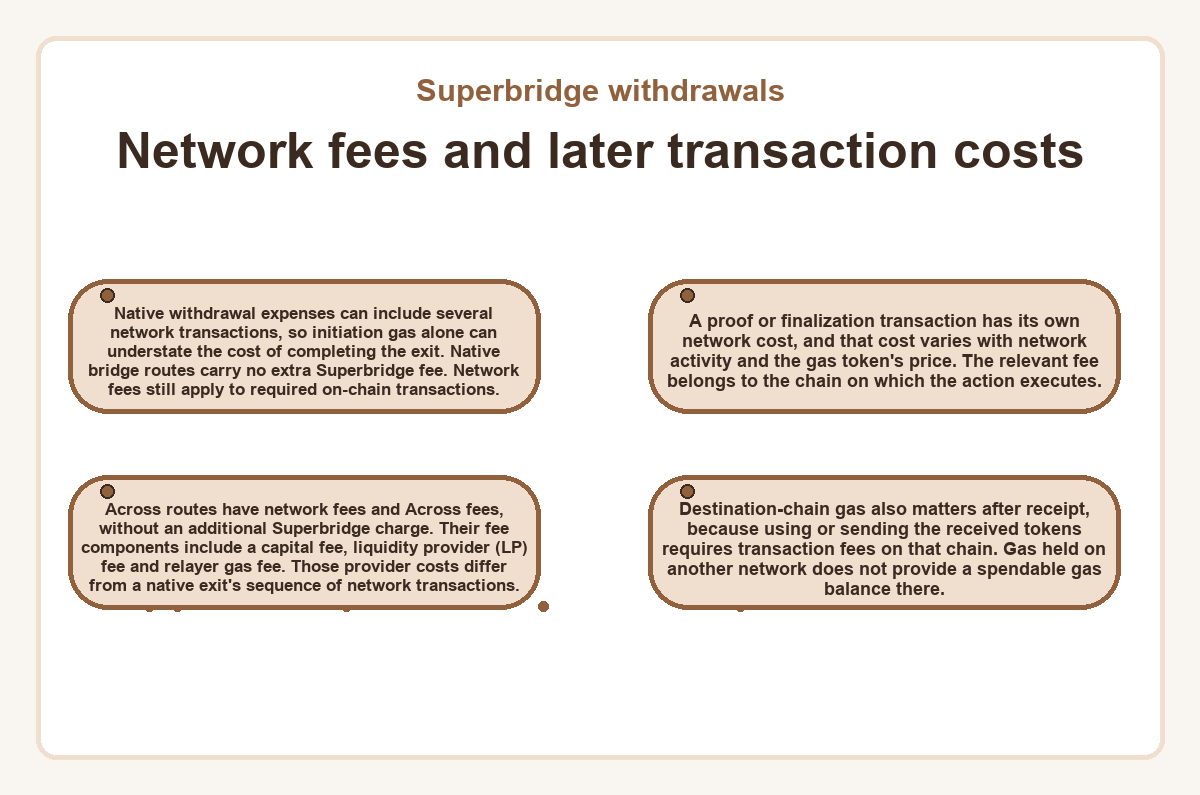
Across routes have network fees and Across fees, without an additional Superbridge charge. Their fee components include a capital fee, liquidity provider (LP) fee and relayer gas fee. Those provider costs differ from a native exit's sequence of network transactions. Destination-chain gas also matters after receipt, because using or sending the received tokens requires transaction fees on that chain. Gas held on another network does not provide a spendable gas balance there.
Unfinished transfers and alternative exits
A started native or CCTP bridge cannot be cancelled and requires its remaining steps and waits to finish before tokens can be received. A transfer still awaiting manual completion needs the outstanding action for its original route, even if a faster option becomes available for new transfers.
Support can locate a delayed withdrawal using the wallet address and initiating transaction hash. Include the blocked step for context, while keeping API and wallet signing keys private.
A faster provider route can serve as an alternative exit before initiation, when it can quote the requested chains and tokens. An initiated native withdrawal remains governed by its original protocol timetable and remaining steps.
What readers ask about Superbridge withdrawals
Can a USDT withdrawal require an allowance reset?
A USDT withdrawal quote may include revokeTokenApproval when an existing nonzero allowance must return to zero before a new approval. Where that reset is required, it must precede tokenApproval and the initiating transaction. These are Ethereum Virtual Machine (EVM) approval transactions; the current allowance determines whether the approval work is necessary.
Which contract should receive token approval for a withdrawal?
Token approval must use the contractAddress in the quote's approval object. That spending contract can differ from the address called by the initiating transaction. Check the allowance using the approval object's tokenAddress, contractAddress and amount, rather than substituting the initiating transaction's destination.
Does the withdrawal API request unlimited approval amounts?
Superbridge's API specifies the minimum required token approval amount and never requests unlimited approval. An integration checks the existing allowance against that amount to determine whether an approval transaction is necessary. The quoted requirement concerns the selected transfer's spending permission.
Why might a CCTP V2 activity identifier fail when requesting a new withdrawal quote?
Some CCTP V2 route provider identifiers are available only for reading activity and cannot construct quotes. An identifier found in an existing withdrawal record can therefore be invalid when used to request another transfer. Activity support and quote construction have different scopes.
What transaction data can an integration fetch for a ready withdrawal step?
getStepTransaction returns the transaction data needed to submit an available withdrawal step. Ethereum Virtual Machine (EVM) objects include to, data and value fields, while Solana Virtual Machine (SVM) transactions return serialized data. Solana signing decodes the base64 payload as a VersionedTransaction before signing and submitting the transaction.
How can the CLI submit a withdrawal without waiting for completion?
The CLI's execute command accepts --no-wait to exit after submitting the initiating transaction without polling until completion. This flag controls the command's monitoring behavior. Any remaining protocol waits or wallet-submitted steps still govern the withdrawal, so command exit alone does not establish that the destination tokens have arrived.
Are separate token approvals required for a Solana withdrawal?
Superbridge's API does not require separate token approval steps for Solana or its other supported non-EVM routes.
Is a null nextCheckTimestamp proof that a withdrawal has finished?
A null nextCheckTimestamp alone does not confirm a completed withdrawal. Null permits an immediate activity check and also appears once all steps are done. The current transaction and wait statuses establish whether work remains; the polling timestamp schedules a check.