Superbridge use cases from quotes to token transfers
Superbridge lets you compare bridge and swap quotes before authorizing a transfer, then follow the selected route through its required steps. A quote supplies transaction data without executing that transaction. Token approvals, signed gasless messages and submitted bridge transactions have different consequences. Native routes, third-party providers and cross-chain swaps suit different tasks. The choice turns on the token you need, the fees you accept and whether later completion steps require your wallet. A return transfer needs its own supported route.
Updated
Quotes, permissions and transfer execution
Route quotes, approvals and activity records answer different questions about the same transfer. The quote describes a proposed execution path and expected output. Approval information describes permission that an Ethereum Virtual Machine (EVM) contract may need before initiation. Activity follows a transfer after submission, showing transactions, waits and remaining actions. These records support both deciding whether to proceed and managing a transfer already underway.
Comparison before commitment
Requesting routes returns provider results containing either a quote or an error. A usable quote includes an initiating transaction, fees and an expected receive amount. Receiving that transaction object does not sign or submit it. Route comparison can therefore stop at returned data when the task is planning rather than moving tokens.
An expected receive amount is a forecast in the quote, not evidence of a completed destination transfer.
Permission and submission
An ERC-20 approval gives a specified EVM contract permission to spend a token. Its required amount must be checked against the current allowance for that contract. A wallet that supports batching can combine approval and initiation in one execution. The permission and transfer remain different operations, even when their calls share a transaction.
Gasless routes use a signed message submitted for relay instead of a transaction sent directly by the user. That signature authorizes execution; it does not establish destination receipt. Signing a gasless message therefore belongs with transfer decisions, even when the wallet displays a signature prompt.
Adjust the plan while it remains a quote
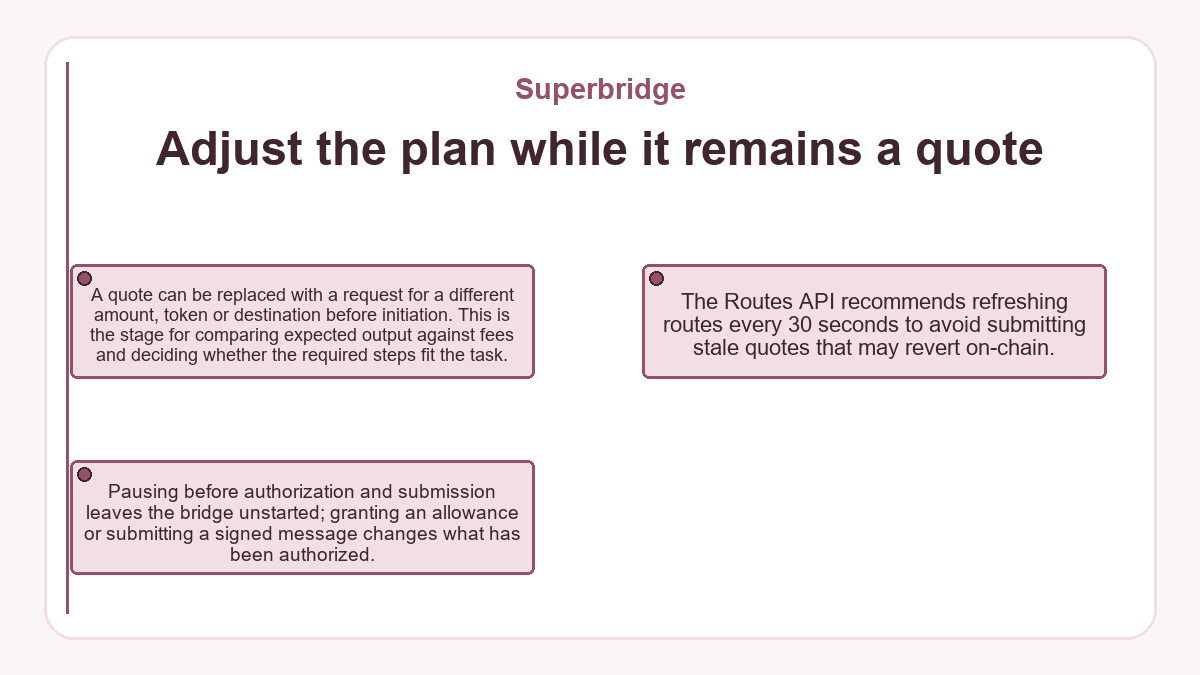
A quote can be replaced with a request for a different amount, token or destination before initiation. This is the stage for comparing expected output against fees and deciding whether the required steps fit the task. The Routes API recommends refreshing routes every 30 seconds to avoid submitting stale quotes that may revert on-chain. Pausing before authorization and submission leaves the bridge unstarted; granting an allowance or submitting a signed message changes what has been authorized.
Match the operation to the required destination asset
A bridge fits a network move when a supported route delivers the intended destination asset. A cross-chain swap fits a move that also needs a different token. Same-chain swaps answer a token-exchange task without adding a network transfer. Each use requires the actual source and destination tokens; a chain name identifies a network, not a currency.
Combining bridging and swapping reduces manual coordination between those operations when the requested combination is supported. Separate bridging followed by a decentralized exchange (DEX) swap can be preferable when no integrated quote fulfills that combination. Each component needs support for its respective token and network selection. An available bridge alone does not establish an available swap.
A confirmed approval with an unstarted bridge
Consider a hypothetical EVM token transfer in which an approval has confirmed, the initiating transaction remains unsubmitted and the quote includes a later manual step. The reader wants to know whether that confirmation means the tokens have already moved.
The approval changed the spending allowance for the contract identified by
contractAddress
. The quote still contains an unsubmitted
initiatingTransaction
that would start the bridge. Refreshing the route can update the proposal, while the confirmed allowance remains an on-chain permission. Closing the quote does not reset that allowance.
The later manual step makes this proposed route unsuitable for a task that requires no subsequent signer. It can fit a transfer whose operator can submit that step when ready. An available quote with automatic follow-up submission would avoid that particular manual action.
Only spending permission has changed; the destination transfer has not started.
Native settlement and faster provider routes
Native routes and third-party routes suit different timing requirements, with completion conditions that need to be understood before initiation.
Native bridge timing
Native rollup routes use the framework's canonical bridge contracts. They suit transfers that prioritize that settlement path and can tolerate its waits. Some optimistic withdrawals include a seven-day challenge period, with proving or finalizing transactions where the framework requires them. Deposits and withdrawals have different lifecycles; a withdrawal estimate should not be applied to a deposit.
Faster exits through a provider
Third-party routes can offer a faster exit than a native withdrawal when a suitable route is available. That choice changes the provider and execution path, including fees and relaying arrangements. It is useful when the native wait conflicts with the intended use of the tokens. Route availability and required actions determine whether the alternative fits.
Route selection does not shorten the challenge period of a native withdrawal that is already underway.
Fees and gas as transfer prerequisites
Native bridge routes need a cost comparison that includes every required on-chain action. Superbridge does not add an extra fee to native bridge transfers. Network fees still apply and can accumulate across approval and completion transactions. Across routes also include provider fees. Destination-chain gas matters whenever later manual actions or token use require it. Gas held on another network does not fund that chain's ordinary transactions, so the origin balance alone cannot establish readiness.
Choose access by the work to be done
Superbridge's app supports wallet-led transfers, while its API and related tools support route queries or execution within another application. The entry point should match how much of the transfer the task needs to manage.
Query and monitoring integrations
The API supplies routes, token data, chain information and activity records. The TypeScript SDK wraps those endpoints with typed requests and responses. Either can serve an integration that compares routes or monitors existing activity without initiating a new transfer. An API key is required; wallet authorization remains a separate prerequisite for execution.
Scripted execution
The CLI has read-only route commands and an
execute
command that handles approvals, submission and indexing, then polls activity and submits follow-up transactions by default. Execution requires signing credentials for the source network's virtual machine and any other virtual machine on which the CLI must sign. A custom integration is preferable when its application needs to decide how and when to sign follow-up steps. Using the wrapper does not change the selected protocol's waiting rules.
Branded rollup interfaces
Rollies provide dedicated branded bridging frontends with wallet integration and transaction tracking. This fits a rollup that needs a user-facing bridge without building the full interface. Direct API integration can suit an existing application that needs its own presentation or execution controls. Branding changes how a route is presented, not its canonical settlement rules.
Returning funds after settlement
Returning tokens to the original network after settlement requires a supported route for the received asset. If that route exists, it is a new transfer with new fees and completion requirements. Quote availability in the outward direction does not establish availability in the return direction.
Once a bridge has started, it cannot be cancelled. Activity records show the protocol steps needed to complete it. Native bridges and
Circle's Cross-Chain Transfer Protocol
(CCTP) can require later transactions to finish delivery. A
ready
step identifies work that can be submitted, while a
done
transaction step confirms that transaction. The whole transfer may still have an unfinished wait or later action.
Resetting an allowance affects future token spending. It neither sends settled tokens back nor recovers network fees already paid.
Answers to common questions
Can a browser app fetch Superbridge quotes without a backend?
A browser interface should call the API through its own backend because the API key must remain server-side. The key identifies the integration account and tracks usage. Keep it out of frontend code and version control; route retrieval and wallet authorization remain separate parts of the integration.
Why does an API transfer amount need a different format from a CLI amount?
The API accepts amount as a string in the token's smallest denomination, while the CLI's --amount uses human-readable token units. The CLI scales that value using the source token's decimals. Passing the CLI value unchanged to the API can request a different transfer amount.
What can make a refreshed quote require another approval?
A refreshed quote can require another approval if its spending contract or required allowance differs from the existing permission. Check the allowance for the token and contractAddress in that quote's approval object. The contract called by the initiating transaction is not always the contract that needs spending permission.
Does a gasless quote remove the need for destination-chain gas?
Gasless initiation covers origin-side submission; later destination-chain actions may still require a gas balance. If a quote lists a later manual transaction, that step still needs gas on the chain where it runs. Subsequent token use can also require destination gas. The selected route's steps determine which follow-up submissions remain.
Which CCTP V2 variants support automatic completion?
CctpV2FastAuto and CctpV2StandardAuto use Superbridge relayers for completion. The forwarder variants use Circle relayers and the wh-executor variants use Wormhole relayers; CctpV2Fast and CctpV2Standard require manual completion. Some identifiers appear only in Activity, so an observed identifier is not necessarily available for constructing a quote.
When is support useful for a transfer that exceeds its estimated duration?
Support is useful when an initiated transfer remains delayed beyond its estimate and an outstanding protocol step needs investigation. OP Stack dispute-game resolution and CCTP attestations can overrun estimates. Include the wallet address and transaction hash so the team can locate the affected transfer.
How should an integration schedule status checks during a long protocol wait?
An integration can schedule Activity requests using nextCheckTimestamp in Unix milliseconds, waiting for a future timestamp or polling immediately when the field is in the past or null, and treating the transfer as complete only when all its required steps are done.